
Ayahuasca visions often include snakes, jaguars, geometric patterns, colors, ancestors, memories and other powerful symbols. But there is no universal ayahuasca symbol dictionary. The meaning of a vision depends heavily on personal context, emotion, culture, the ceremony itself and what becomes relevant during integration.
Perhaps you saw a snake coil around your body. An animal looked directly at you. A deceased relative appeared. Or you moved through endless geometric structures, plants, eyes, colors, death, rebirth or something you still can't describe.
These experiences can feel profoundly meaningful. The difficult part is deciding what to do with them afterward.
A useful distinction is:
-
What you actually experienced
-
What you initially thought it meant
-
What meaning, if any, emerges through integration
That leaves room for spiritual interpretation without pretending that every vision can be translated using an online symbol dictionary.
Why Does Ayahuasca Produce Such Vivid Visions?
Ayahuasca can produce unusually vivid internal imagery, sometimes even with the eyes closed.
Neuroimaging research has found increased activity during ayahuasca-induced imagery in brain regions involved in visual processing, memory and internally generated information. In one small functional MRI study, activity in the primary visual cortex during imagery reached levels comparable with those observed while participants viewed natural images with their eyes open. Research: de Araujo et al., Human Brain Mapping
That helps explain why a vision can feel less like imagining something and more like witnessing it.
Science can investigate processes involved in visual imagery. It cannot tell you that the snake you saw objectively represented your marriage, that a deceased relative literally visited you or that a particular color predicted something about your future.
Those are different questions.
Ayahuasca experiences can combine perception, emotion, autobiographical memory, bodily sensation, expectation and meaning-making. Reducing them to "just hallucinations" can miss how significant they feel to the person experiencing them.
The opposite mistake is assuming that because something felt completely real, the first interpretation must also be objectively true.
Do Ayahuasca Symbols Have Universal Meanings?
Generally, no.
Recurring themes do appear in reports of ayahuasca experiences. Serpents, large cats, birds, human-like beings, landscapes and geometric imagery have all been documented in research and ethnographic accounts. Benny Shanon's review of recurring ayahuasca vision content
But recurring imagery is not the same as recurring meaning.
The possible meaning of a symbol can be influenced by:
-
personal memories
-
fears and desires
-
emotional state
-
current relationships
-
expectations before ceremony
-
religious or spiritual beliefs
-
cultural background
-
events earlier in the ceremony
-
music and other aspects of setting
-
previous ceremonies
-
what happens after the experience
Traditional interpretations also shouldn't be flattened into a generic "Indigenous meaning."
There are many Indigenous peoples and ceremonial traditions associated with ayahuasca and yagé. They have distinct languages, cosmologies and ways of understanding visionary experience. An interpretation documented within one tradition shouldn't automatically be presented as what all Indigenous people believe.
A useful way to think about an ayahuasca vision
Observation: What actually happened?
Interpretation: What do I think it meant?
Integration: What, if anything, changes because of it?
Keeping these separate can prevent an immediate interpretation from becoming a certainty before you've had time to reflect.
Samuel Vélez, a Camino al Sol facilitator, puts that boundary simply:
“That vision was for you. They saw that you needed to understand that, so you must live it in your life. Don't expect everybody else to believe it or live according to it. Think about how you can bring that reality into your actions.”
The point isn't that a vision has no meaning. It's that personal meaning shouldn't automatically become a universal claim.

A Colombian Yagé Perspective
Internationally, ayahuasca has become the dominant term. In Colombia, the medicine is commonly known as yagé.
That distinction matters because ceremony doesn't happen independently of culture.
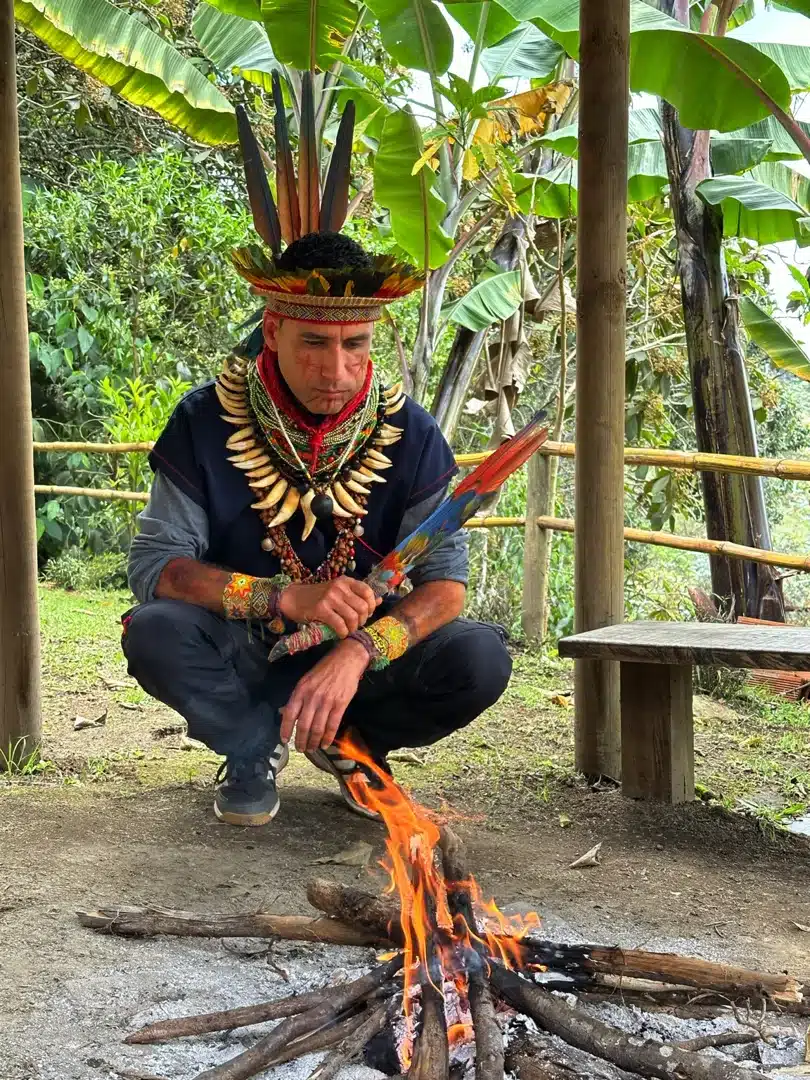
At Camino al Sol in El Retiro, Antioquia, near Medellín, ceremonies take place within a Colombian yagé context with experienced Taita guidance, ceremonial music, preparation, screening and integration.
Traditional guidance can offer context that a participant doesn't have. At the same time, an experienced practitioner doesn't need to pretend that every image has one fixed translation.
The participant's own history and emotional response still matter.
Taita Diego Marmolejo describes the role of personal state from within his own tradition:
“It depends on how you think, how you feel, and how your heart is. If there is humility and respect, the visions are one thing.”
That is a traditional perspective, not a fixed decoding rule. It reinforces why context matters.
Our guide to yagé in Colombia explains more about the Colombian context and how it differs from the increasingly generic international idea of an "ayahuasca experience."
Common Symbols and Themes in Ayahuasca Visions
Certain images appear often enough to deserve closer attention. The following are possibilities for reflection, not definitions.
Snakes and Serpents
Snakes are among the most frequently discussed animals in ayahuasca imagery.
That makes the question "What does a snake mean on ayahuasca?" particularly vulnerable to oversimplification.
Transformation is one common modern interpretation, often connected with shedding skin. Other people associate snakes with fear, danger, sexuality, medicine, renewal, power, nature or protection.
But consider two different experiences.
One person sees a huge serpent approaching and feels terrified. The vision appears immediately after a painful childhood memory.
Another feels a serpent wrap around their body and experiences unusual safety and calm.
Calling both experiences "transformation" because an online article says snake = transformation removes most of the information that could actually matter.
Instead ask:
-
What was the snake doing?
-
How did you feel when it appeared?
-
Did you resist it or welcome it?
-
What happened immediately beforehand?
-
What changed afterward?
-
Have snakes had personal significance in your life?
-
Has the image appeared before?
The snake may begin the inquiry. It doesn't necessarily end it.
Jaguars and Other Powerful Animals
Jaguars and other large felines also appear in ayahuasca accounts and Amazonian visionary traditions.
People may associate a jaguar with strength, instinct, protection, danger, stillness or personal power.
The relationship matters.
Being chased by a jaguar is different from becoming one. Being protected by one is different from being attacked.
A useful question is:
What quality did the animal bring into the experience?
Fear? Confidence? Predatory force? Protection? Embodiment? Stillness?
That may tell you more than simply searching for the spiritual meaning of a jaguar.
Birds and Other Animals
Birds, insects, butterflies, spiders, fish, dogs, felines and unfamiliar creatures also appear in people's visionary reports.
With any animal, start with a few simple questions:
-
What do I personally associate with this animal?
-
How did I feel around it?
-
What was happening between us?
-
Where else does this theme appear in my life?
A hummingbird, for example, may feel deeply significant to someone without there being one universal "hummingbird meaning" that applies to every ayahuasca vision.
Plants, Vines and Trees
Roots, vines, forests, flowers and trees can carry strong emotional or symbolic weight.
Someone may experience roots as ancestry or connection. A forest may feel protective or threatening. A flowering plant may coincide with tenderness, grief or release.
Plant imagery also deserves cultural care.
Within traditions where particular plants carry established ceremonial relationships and teachings, those meanings belong within a broader system of knowledge. They shouldn't be extracted and turned into generic internet symbolism.
Geometric Patterns, Spirals and Fractals
Intricate geometry is one of the most recognizable forms of psychedelic visual imagery.
People describe:
-
grids
-
spirals
-
tunnels
-
lattices
-
symmetry
-
repeating shapes
-
rapidly transforming patterns
-
mosaic-like structures
-
architecture made of geometry
-
imagery that appears synchronized with sound
Researchers have studied possible perceptual mechanisms behind geometric psychedelic imagery. Ethnographic work has also documented sophisticated relationships between visionary patterns, art and cosmology within specific Amazonian traditions. Museo Chileno de Arte Precolombino on Amazonian visionary imagery
Those perspectives aren't necessarily contradictory.
One can ask how patterned imagery becomes possible.
Another can ask what relationship a culture or individual develops with that imagery.
Sometimes geometry may not need to be decoded at all. Its significance may simply be the experience of seeing something extraordinarily intricate.
Colors
Colors during ayahuasca can appear unusually bright, luminous or saturated.
It is tempting to reduce them to formulas:
Red means passion.
Blue means peace.
Green means healing.
Context is more useful.
Red might evoke love, danger, blood, anger, warmth or a specific childhood memory. Green might remind one person of a forest and another of a hospital.
If a particular color dominates an experience, consider:
-
What does this color already mean to me?
-
What emotion accompanied it?
-
Was it connected with a person, place or animal?
-
Did the color change?
-
Has it appeared repeatedly?
The goal isn't to avoid symbolism. It is to avoid confusing a useful association with an objective translation.
Eyes, Faces, Beings and Deceased Relatives
Some of the most memorable ayahuasca visions involve a sense of encountering another presence.
People sometimes describe:
-
eyes watching them
-
unfamiliar faces
-
human-like beings
-
ancestors
-
deceased relatives
-
spiritual figures
-
apparently autonomous entities
There are different ways of understanding these experiences.
A spiritual interpretation may regard an encounter as contact with an ancestor or another form of consciousness. A psychological interpretation may understand it through memory, attachment, grief, expectation or internally generated imagery.
It isn't necessary to force one explanation.
If a deceased relative appeared, the more useful questions may be:
What happened between you? What emotion arose? Was something left unsaid? Did the encounter change how you relate to grief afterward?
An experience can be meaningful even when its metaphysical explanation remains unresolved.
Death and Rebirth
Experiences of dying, disappearing, dissolving or being reborn also occur in psychedelic reports.
Sometimes these overlap with what researchers call ego dissolution, a temporary alteration or weakening of the ordinary sense of being a separate, stable self.
People may understand these experiences as surrender, symbolic death, purification, rebirth or spiritual transformation.
The important part is what follows.
Did the experience change your priorities? Your relationship with mortality? The identity you were trying to protect? The way you treat other people?
Profound visions can sometimes become part of what people later describe as a spiritual awakening or spiritual transformation. But an intense experience isn't automatically a durable transformation.
Childhood, Family and Memories
Not every ayahuasca vision looks mystical.
Sometimes it is a childhood bedroom. Your mother's face. A school corridor. Your children. An argument. A former partner. Something you haven't consciously thought about for years.
Autobiographical material can carry enormous emotional weight.
It should also be approached carefully.
A vivid scene experienced during ayahuasca isn't automatically evidence that an event happened exactly as it appeared. Human memory is reconstructive, and visionary states aren't reliable forensic tools for establishing historical facts.
Instead of immediately concluding, "I recovered a hidden memory," begin with what you actually know:
This image appeared. It affected me strongly. Why might this material matter to me now?
If visionary material involves possible trauma or serious allegations about another person, an appropriately qualified mental-health professional may be more useful than trying to establish certainty through symbolic interpretation.
Music and Sound
Music is particularly important because a ceremony isn't simply a person taking ayahuasca in an empty room.
Research across psychedelic settings suggests that music can influence emotion, imagery, autobiographical material and the perceived trajectory of an experience. Research on music and psychedelic experiences
In traditional ceremonial contexts, music has a role beyond entertainment or background ambience.
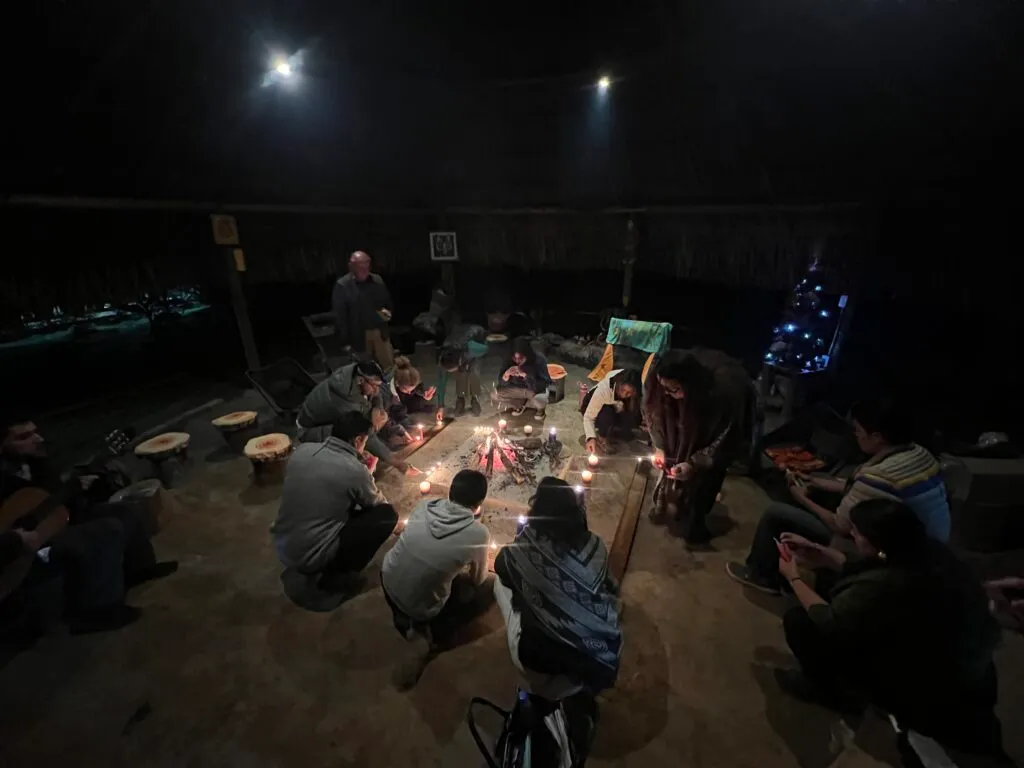
Within the Colombian yagé ceremonies held at Camino al Sol, music, prayer, voice, rhythm and the work of the Taita are part of the ceremonial setting itself.
A participant may notice imagery changing with a song. Memories may emerge. Attention may shift. A difficult part of an experience may change direction.
That doesn't mean a particular song produces one predictable psychological effect.
It means that when reflecting on a vision, it can be useful to remember what was happening in the ceremony when the image appeared.

Why Do Some Symbols Repeat?
A snake appears in several ceremonies.
The same house keeps returning.
A particular person repeatedly appears.
You enter the same landscape or encounter the same geometric structure again and again.
Repetition is worth noticing.
It might relate to an unresolved emotional concern, a deeply established memory, expectation, fear, personal association or something you understand spiritually.
You don't need to decide immediately.
Record:
-
when the image appears
-
what happens before it
-
how you feel
-
what changes each time
-
what remains the same
-
what is happening in your life between appearances
Recurring ayahuasca visions become more useful when explored as a pattern rather than decoded from a single appearance.
What If You Don't Have Any Visions?
Nothing is necessarily wrong.
Spectacular visions aren't required for a meaningful yagé experience.
Some experiences are highly visual. Others center on emotion, bodily sensation, memory, thought, music or simple presence.
Some ceremonies can also feel subtle, confusing or uneventful.
Chasing visions can become a distraction, especially when expectations have been built from stories about snakes, jaguars and impossible geometric worlds.
The purpose of ceremonial work isn't to collect impressive imagery.
A quiet realization that changes how you relate to your family may ultimately matter more than seeing an entire universe behind closed eyes.
Should You Google the Meaning of Your Ayahuasca Vision?
You can. Just don't confuse the search result with the answer.
Suppose you search:
snake ayahuasca vision meaning
You will quickly find descriptions involving transformation, rebirth, healing and shedding old skin.
Maybe one of those ideas genuinely helps.
But perhaps you were terrified of snakes as a child.
Perhaps your grandfather kept snakes.
Perhaps the serpent appeared while you were thinking about your marriage.
Perhaps it attacked you.
Perhaps it protected you.
Perhaps you felt no fear at all.
All of that disappears when interpretation becomes:
Snake = transformation.
Symbol dictionaries can offer associations you hadn't considered. Use them as prompts, not authorities.
The better question is not simply:
What does this symbol mean?
It is:
What relationship does this symbol have to the rest of my experience and to my life?
How to Interpret an Ayahuasca Vision
Interpretation usually improves when you slow it down.
1. Record what happened before deciding what it meant
Write the experience as literally as you can.
Observation:
"I saw a black snake wrap around my body."
Interpretation:
"It was removing negative energy."
Don't confuse the two yet.
2. Identify the strongest emotion
Were you:
-
frightened
-
safe
-
amazed
-
disgusted
-
loved
-
sad
-
curious
-
calm
Emotion often provides more context than the symbol itself.
3. Explore your personal associations
Ask what the image meant to you before ayahuasca.
If you saw a dog and your childhood dog was your closest companion, that matters.
If you're terrified of dogs, that matters too.
4. Reconstruct what was happening around the vision
What happened immediately before it?
What music was being played?
Were you remembering someone?
Were you resisting an emotion?
What happened afterward?
Visions occur in sequences. Pulling one image out of the sequence can alter its apparent meaning.
5. Look for repetition
If the same animal, person, place or theme returns, write it down.
Don't rush to explain the repetition. Notice what changes.
6. Consider cultural interpretations carefully
Traditional teachings can provide valuable context when they come from people who actually carry those traditions.
That isn't the same as searching "Indigenous snake meaning" and combining beliefs from unrelated peoples.
Specificity matters.
7. Allow more than one interpretation
A vision doesn't necessarily need one correct answer.
A snake might simultaneously evoke a personal memory, fear, instinct and transformation.
Ambiguity isn't failure.
8. Discuss important material during integration
Another person can't necessarily tell you what your vision meant.
But a useful integration conversation can expose assumptions you haven't noticed.
Instead of asking:
What did the jaguar mean?
You may discover the more important question is:
Why did feeling powerful make me afraid?
Our ayahuasca integration resources focus on what happens after ceremony because insight becomes useful when it can be related responsibly to everyday life.
9. Watch what becomes meaningful afterward
Some visions make little sense the next morning.
Months later, they do.
Others feel like absolute truth during ceremony and seem much less convincing after sleep, reflection and distance.
Give important experiences time.
Integration includes discovering which insights remain useful after the altered state has passed.
Ayahuasca Visions vs Dreams
Ayahuasca visions and dreams share some obvious qualities.
Both can combine:
-
memory
-
emotion
-
people
-
places
-
symbols
-
impossible events
-
experiences that feel deeply meaningful
They aren't identical states, and dream theory shouldn't simply be copied onto ayahuasca.
But there is one useful similarity.
Thoughtful dream interpretation rarely assumes that seeing water, a snake or a house means exactly the same thing for every person.
Personal context matters.
The same principle applies to the spiritual meaning of dreams and to ayahuasca vision interpretation.
Ayahuasca Visions and Spiritual Awakening
A profound experience can sometimes change how someone thinks about identity, relationships, nature, spirituality or what matters in life.
People may describe this as a spiritual awakening or spiritual transformation.
Ayahuasca doesn't reliably produce either.
A dramatic experience may become a turning point. It may also leave someone confused or emotionally unsettled.
The important question is whether insight becomes part of ordinary life.
A vision about compassion matters differently if you actually become more compassionate.
An experience of interconnectedness matters differently if it changes how you treat people after you return home.
Intense spiritual experiences sometimes also intersect with periods people describe as a dark night of the soul. That deserves its own discussion rather than being reduced to another ayahuasca symbol.
When a Vision Feels Disturbing or Difficult
Not every ayahuasca vision is beautiful.
Experiences can include:
-
frightening imagery
-
apparent death
-
threatening figures
-
painful memories
-
confusion
-
overwhelming fear
Avoid reducing all of this to:
"The medicine only shows you what you need."
We cannot know that.
A difficult experience may later become meaningful. It may also simply have been extremely difficult.
If distress continues after ceremony, symbolic interpretation shouldn't replace appropriate care.
Persistent severe confusion, major impairment, suicidal thinking, mania, psychosis-like symptoms or inability to function normally warrants professional evaluation. Published literature includes rare reports of psychotic reactions associated with ayahuasca use, particularly where underlying vulnerability may be present. Systematic review of ayahuasca and psychosis reports
This is one reason responsible screening matters before ceremony.
Read more about Camino al Sol's ayahuasca safety and screening approach.
Integration Matters More Than Finding the Perfect Interpretation
There is a seductive idea that somewhere there is a perfect translation of your vision.
Find the right Taita, therapist, book, Reddit comment or symbolism website and everything will suddenly make sense.
Sometimes guidance helps enormously.
Sometimes there isn't one clean answer.
The more useful question is often not:
What did this symbol objectively mean?
but:
What relationship does this experience have to the way I'm living?
Perhaps you saw yourself forgiving your father.
What happens when you speak to him?
Perhaps you became a jaguar and felt powerful.
Where in ordinary life do you avoid your own strength?
Perhaps you experienced your death and returned with overwhelming gratitude.
What changes because you're grateful?
A vision can be extraordinary.
Integration asks whether anything becomes different when you come home.
If you're currently trying to make sense of an experience, start with our guide to ayahuasca integration and support.
Exploring Yagé With Camino al Sol
Understanding visions is only one part of working responsibly with yagé.
Camino al Sol holds traditional Colombian yagé retreats in El Retiro, Antioquia, near Medellín, with preparation, screening, ceremonial guidance, music and integration as parts of the wider process.
If you're still deciding whether this work is appropriate for you, begin with our guides to yagé in Colombia and ayahuasca safety.
If you want to understand the retreat itself, you can also read about our traditional ayahuasca and yagé retreats in Colombia. Participation begins with screening rather than instant booking.
